

Whether you are managing a dedicated server room, telecom closet, edge-computing environment, or a single rack of mission-critical IT equipment, maintaining the proper temperature and humidity is essential to reliable operation.
As IT equipment becomes more powerful and rack densities increase, understanding the fundamentals of IT cooling is increasingly important for IT professionals, facility managers, and HVAC contractors.
Proper IT cooling involves more than simply keeping a room cold. The cooling system must remove the heat generated by the equipment, deliver conditioned air to the equipment inlets, maintain appropriate temperature and humidity conditions, and provide enough capacity to handle the current and anticipated IT load.
The objective is not simply to install the largest air conditioner available. The objective is to provide the right amount of cooling capacity for the IT load while maintaining appropriate environmental conditions at the equipment inlet.
Understanding ASHRAE TC 9.9 Temperature and Humidity Guidelines
One of the most widely recognized references for IT environmental conditions is ASHRAE Technical Committee 9.9 (TC 9.9), Mission Critical Facilities, Data Centers, Technology Spaces and Electronic Equipment.
ASHRAE’s Thermal Guidelines for Data Processing Environments provides recommended and allowable environmental conditions for information technology equipment. The guidelines are intended to help facility designers and operators balance equipment reliability, energy efficiency, and operating costs. (ASHRAE)
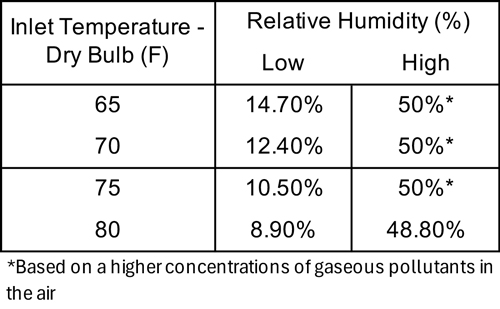
For conventional air-cooled IT equipment in Classes A1 through A4, ASHRAE TC 9.9 recommends a dry-bulb temperature range of 64–81°F (18–27°C). Its current guidelines also recognize that modern IT equipment can operate reliably across a much wider range of humidity than historically recommended. Depending on equipment class and temperature, the recommended relative humidity range is determined by the wet bulb temperatures: 16°F to 59°F (-9°C to 15°C). To make this easier to understand, we have translated the recommended conditions into more practical terms in the following chart.
ASHRAE TC 9.9's Thermal Guidelines for Data Processing Environments - 5th Edition
Why Humidity Matters
Humidity is an important consideration in IT environments—but the need for tight humidity control has changed.
Historically, data centers maintained narrow humidity ranges to minimize the risk of electrostatic discharge (ESD) at low humidity and condensation or corrosion at high humidity. However, ASHRAE research demonstrated that modern IT equipment is far less susceptible to ESD at low relative humidity than previously believed. As a result, ASHRAE significantly expanded its recommended moisture envelope, allowing IT equipment to operate reliably across a much broader range of conditions.
For many small IT environments, this means dedicated humidification or dehumidification is no longer necessary. ASHRAE’s current guidance emphasizes maintaining appropriate temperature and moisture conditions—particularly avoiding condensation—rather than tightly controlling relative humidity (RH).
For practical IT cooling applications, the key takeaway is simple:
Control the air conditions at the IT equipment inlet, not simply the conditions somewhere else in the room.
A server may be located in a room that feels comfortable to occupants while still receiving air that is too warm because of poor airflow distribution, hot-air recirculation, or inadequate cooling near the rack.
IT equipment generates heat → hot air is captured → heat is removed → conditioned air returns to the equipment inlet.
The more effectively this airflow path is controlled, the less cooling energy is wasted conditioning air that never reaches the IT equipment.
Understanding Server Rack Cooling Capacity
One of the most important concepts in IT cooling is understanding how much cooling capacity a server rack actually requires.
Cooling capacity is commonly expressed in BTU/h or kW.
The basic conversion is:
1 kW of heat load ≈ 3,412 BTU/h of cooling
For example:
| IT Heat Load | Approximate Cooling Requirement |
| 2 kW | 6,824 BTU/h |
| 3 kW | 10,236 BTU/h |
| 4 kW | 13,648 BTU/h |
| 5 kW | 17,060 BTU/h |
| 10 kW | 34,120 BTU/h |
Because nearly all electrical power consumed by IT equipment ultimately becomes heat, the electrical load of the equipment provides a useful starting point for estimating the required cooling capacity.
However, the cooling capacity of an air-conditioning system should not be compared to an IT load without understanding whether the rating represents total cooling capacity or sensible cooling capacity.
Total vs. Sensible Cooling Capacity
Air-conditioning equipment can remove both sensible and latent heat.
Sensible cooling is the reduction in air temperature. This is generally the dominant cooling requirement for electronic equipment because servers continuously convert electrical energy into sensible heat.
Latent cooling removes moisture from the air.
For example, the DENSO EdgeCool 5 Series is rated at 15,400 BTU/h (4.5 kW) total cooling capacity and 13,600 BTU/h (4.0 kW) sensible cooling capacity under its published rating conditions. (EdgeCool)
That distinction matters. A 4 kW IT heat load should not automatically be matched to a cooling system simply because the system has a 4.5 kW total cooling rating. The designer should verify the equipment’s sensible capacity under the expected operating conditions and provide appropriate capacity margin.
Matching Cooling Capacity to the Application
The physical environment also matters.
Some installations have limited floor space. Others cannot accommodate exterior penetrations, refrigerant lines, ductwork, or major building modifications. Remote and industrial applications may also experience elevated temperatures, dust, moisture, or other challenging conditions.
In these situations, a cooling solution designed specifically around the rack can provide an alternative to conditioning the entire room.
A Different Approach to IT Cooling: EdgeCool
DENSO EdgeCool takes a rack-level approach to IT cooling by turning a standard server rack into a self-contained, portable cooling environment. Its integrated split-system design provides targeted cooling directly where heat is generated without requiring additional floor space, building modifications, or external ductwork.
Why EdgeCool?
- Targeted, High-Sensible Cooling – Delivers cooling directly to IT equipment while efficiently removing the heat it generates.
- Controlled Airflow – Separates hot exhaust air from cool intake air to help maintain consistent equipment inlet temperatures.
- Simple, Flexible Installation – Works with new or existing racks and operates on standard 120 V/20 A power, with no major building modifications required.
- Reliable 24/7 Cooling – Designed for continuous operation as a primary, supplemental, or backup cooling solution.
- Portable by Design – The cooling system moves with the rack, making it ideal for changing or distributed IT environments.
From server rooms and telecom closets to industrial facilities and edge-computing applications, EdgeCool provides a practical alternative when cooling an entire room is unnecessary, inefficient, or difficult to implement.
The Bottom Line
Effective IT cooling isn’t necessarily about cooling the entire room—it’s about delivering the right amount of cooling where the heat is generated.
ASHRAE TC 9.9 provides the framework for maintaining appropriate temperature, humidity, and equipment inlet conditions. From there, the cooling strategy should be matched to the actual IT heat load, airflow requirements, and physical environment.
For smaller, distributed, or difficult-to-condition IT spaces, cooling the rack instead of the room can be a smarter approach. By delivering dedicated, high-sensible cooling directly to the IT equipment, unique solutions like EdgeCool eliminate the need to condition unused space and can reduce the complexity, cost, and infrastructure required to protect critical equipment.
Learn More About EdgeCool
When mission-critical IT equipment needs reliable, targeted cooling, DENSO EdgeCool delivers a compact, efficient, and portable “room-in-rack” solution designed specifically for smaller IT environments.
Learn how EdgeCool can help protect your IT equipment while simplifying your cooling strategy.
Technical Reference
ASHRAE TC 9.9, Thermal Guidelines for Data Processing Environments, Fifth Edition, Revised and Expanded (2021, revised 2024). The ASHRAE TC 9.9 reference card provides the recommended and allowable environmental conditions for air-cooled IT equipment and high-density servers. ASHRAE TC 9.9 Thermal Guidelines Reference Card